|
The City of Saint
Mary of the
Angels
est. 1781 by Spain
Travel photos & tips, art
and
views from Los Angeles
and the Pacific Coast we've got
western sunsets, hidden gems, gossip and lore.
Welcome to the
great city of Los Angeles, USA!
NEW - Drop by our new AngelCityArt Blog to
find out what's up!
|
LA
Photos and Tidbits
|

|
Newest Photo:
Japanese Cherry Trees in bloom at Balboa Lake.
|
|
The Santa Ana Winds
Hot, dusty Santa Anas
carry a large number of positive ions and have been called 'Devil
Winds'. Read more and get tips on
dealing with our dry winds on our Southern
California Weather Page...
|

Sport Driving in Los Angeles
Driving in
California is always an adventure. In Los Angeles driving has
been elevated to an art form. Our LA Traffic Page
has driving tips,
rantings, danger and drama.
|

Sepulveda Dam
Basin in the Valley
The dusty intersection of Woodley
and Burbank in the
center of the
basin in the San Fernando Valley. The dam basin is part of the
flood control system for Los Angeles. |

Sepulveda Tunnel,
Sepulveda Pass
A bent Falling Rock sign at the
entrance to the
Sepulveda
Tunnel. Until the 405 freeway
was built, this was the only way through the Pass. Visit our page
for more photos of the
Sepulveda Tunnel... |

Sherman Oaks Galleria
in 'the Valley'
The Tower Records Store at the
Galleria occupies the
corner facing the intersection of Sepulveda Blvd. and Ventura Blvd.,
one of the nation's busiest intersections. |

Edgar Rice Burroughs
HQ,
Tarzana
The former home of Edgar Rice
Burroughs, and now ERB
Headquarters in
Tarzana, California. The town of Tarzana of course, was named for
his famous character Tarzan. |
Encounters Restaurant
Roams LAX at Night
In this photo
the restaurant looks
like
a giant purple alien bug. It's stepping over the fence to go meet up
with Godzilla for a quick drink in Hollywood. |
LAX Encounters
Restaurant Tamed
The restaurant
in daylight.
This
fabulous example of 1960's architecture could be called the ultimate
Googie building. |
|
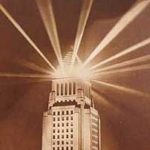
LA
City Hall Dedicated April 28, 1928
The top of the tower was designed
to resemble the
Mausoleum at
Halicarnassus, one of the Seven Wonders of the Ancient World.
Concrete used in the tower contained sand taken from each of
California's 58 counties and mixed with water from each of its 21
missions.
The Charles Lindbergh Beacon, an aircraft guidance light, was recovered
from a warehouse, restored, and replaced atop the building during the
2001 renovation. |
|
Los Angeles Native
People & History
The area now known as Los
Angeles County has been
continuously occupied by several native American nations since
prehistory. The bulk of Los Angeles city was occupied by the
Tongva Nation.
Along the Pacific coast the Chumash occupied what is now Malibu
north
to San Luis Obispo County. The Tataviam lived in the
northern San
Fernando Valley.
The Tongva and Chumash also lived on the islands off
the California
coast and are both known as great seafarers. It is believed among
some
researchers that they had contact with the oceangoing prehistoric
Polynesians.
European contact began as early as 1542 when a
Tongva
boat (ti'at) sailed out to greet Spanish explorer Juan Cabrillo off the
shores of present-day San Pedro.
When the first missions were established by Spain, the Spanish habit
was to name
their new Native American 'neophytes' after the mission they were
restricted to. Subsequently the Tongva people were renamed the
Gabrielino, the Tataviams in the San Fernando Valley were renamed
Fernandeños.
Modern place-names with Tongva origins include:
Azusa, Cahuenga (Pass),
Cucamonga (Rancho), Pacoima, Topanga, and Tujunga
Modern place names with Chumash origins include:
Castaic (Lake),
Malibu, Mugu (Point), Ojai, Piru, and Simi (Valley).
For sources and indigenous California tribes visit my LA Links Page…
|
|
The
San Fernando Valley
- it's part of
LA - really
After the Northridge earthquake I was aggravated to hear newscasters
say the San Fernando Valley was 'near Los Angeles'. That's like
saying 'Queens is near New York' or 'The French Quarter is near New
Orleans'. I'd like to try, in my own feeble way to explain the
Valley to the rest of you out there – especially those of you on the
other
side of The Hill.
Take a city and plop a mountain range down through the middle of
it. It's called 'The Valley' because it is separated from
downtown LA and roughly the southern half of the city by the Santa
Monica Mountains.
Tom Petty sings about long days in Reseda, eccentric residents of
Encino have owned llamas and chimps, and Frank Zappa and daughter Moon
Unit sung about Valley Girls. Yes, I’m a Valley Girl, but you’re
not supposed to call me that because it’s an insult – like, gag me with
a spoon, you know! The Valley has been looked down upon by the
Westside,
dismissed as a bedroom community by Downtown, maligned as a long series
of strip malls by –you know who you are. It has been said the
Valley is to LA what Canada is to the United States. Or even, the
Anti-Los Angeles.
The Real Valley
We are none of these things, except sometimes, maybe a little.
The Valley was annexed by the city of Los Angeles in 1917 and tried to
secede in 1980. There are genteel church socials in Toluca Lake
while porn is a growth industry in Chatsworth. Movie stars eat at
kosher delis in Studio City or you can get the best tacos north of the
border in Van Nuys. These areas - Northridge included - are all
part of the San Fernando Valley and the San Fernando Valley, like it or
not, is part of the city of Los Angeles. No kidding. Look
for us up in the northeast corner of the map.
The Early Years
The Valley was inhabited by members of the Tongva Indians (renamed
Fernandino and
Gabrielino by the Spanish) since pre-history. It was an ancient
Indian footpath that led Spanish explorer Gaspar
de Portola through a mountain range and down into a peaceful valley
covered with oak trees. Ignoring the enormous village of Indians
who had already titled their city, he named the area Los Encinos (The
Oaks).
He promptly forgot about it (figures), because later the area was
rediscovered and called the Lost City of Los Encinos. As if in
penance, Signor Portola’s tortuous journey is memorialized daily by
commuters trapped in traffic on the 405 Freeway.
In 1797, Mission San Fernando Rey de España was founded as a stopping
point for weary travelers on El Camino Real (The King's Road). This
roadway is now called Ventura Boulevard and is the unofficial main drag
of the Valley. It hugs the northern length of the Santa Monica
mountains from the northwest corner in Woodland Hills, then southeast
past Universal City until plunging into the Hollywood Pass where it
changes names to the Cahuenga Pass. Ventura Blvd. is roughly
paralleled by the Ventura Freeway which goes northeast into Ventura
County.
You're Stuck With Us
Yup, the San Fernando Valley, like it or not, is part of the city of
Los Angeles. No kidding. So lets all try to get along
together.
I found this excellent website with more info on the origin of street
names in the San Fernando Valley here: http://www.americassuburb.com/streets.html
For more info on the Los Angeles native Tongva visit the Laurel
Canyon Assoc.
|
|